据历史学者介绍,3000多年前,周朝以“日影”最长的一天作为新一年的开始。从这个意义上说,冬至就是曾经的年。所以中国有句古话说:“冬至大如年”。
As early as Zhou Dynasty, people worshipped the gods on the day of the Winter Solstice, which was also the first day of the new year. The Winter Solstice became a winter festival in Han Dynasty. The celebratory activities were officially organized. On this day, both officials and common people would have a rest.
1、吃坚果(Nuts)
隆冬来临,万物运转趋于停歇。在此期间,适当地吃点坚果,例如花生、核桃、栗子、榛子和杏仁,对身体有好处。传统中医学认为,坚果性温,绝大多数坚果都有补肾、强心、健脑的功效。
Winter is in full swing, and all living things slow down their rhythms. During this period, eating an appropriate amount of nuts -- such as peanuts, walnuts, chestnuts, hazelnuts and almonds -- is beneficial to your health. Traditional Chinese medical science teaches that the quality of a nut is tepidity and most nuts have the function of nourishing the kidneys and strengthening the brain and heart.
2、吃饺子(Dumplings)
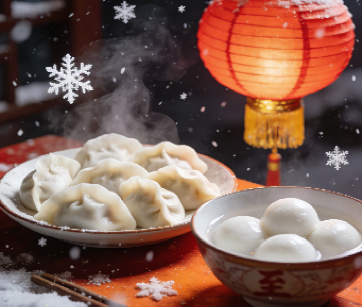
“冬至到,吃水饺。”据说,冬至吃水饺的习俗是为纪念“医圣”张仲景。行医途中,他见沿途乡民饥寒交迫,耳生冻疮,便用羊肉等材料制成耳朵 形状的“娇耳”,送给人们驱寒。这便是“饺子”的由来。 在中国北方地区,吃饺子是冬至的关键活动。俗话说:“冬至饺子夏至面。”
“Eat dumplings when the Winter Solstice arrives.” It is said that the custom of eating dumplings on the Winter Solstice originated to commemorate Zhang Zhongjing, the Medical Sage. On his medical practice journey, he saw the villagers along the way suffering from hunger and cold, with chilblains on their ears. He then made ear-shaped Jiao’er with mutton and other ingredients and gave them to the people to ward off the cold. This is how dumplings came into being. During Winter Solstice in North China, eating dumplings is essential to the festival. There is a saying that goes “Have dumplings on the day of Winter Solstice and noodles on the day of Summer Solstice.”
3、馄饨 (Wontons)
苏州人习惯在隆冬时节吃馄饨。相传苏州百姓把馄饨作为庆祝冬至的食物,是为了纪念大美人西施。
People in Suzhou are accustomed to eating Wontons in the depth of winter. According to legend, the locals of Suzhou eat Wontons as a food to celebrate the Winter Solstice, in memory of the great beauty Xishi.
据传,在2500年前的吴国宴席上,吴王厌倦了山珍海味,想换个口味。美人西施去厨房做了一道叫“馄饨”的菜来满足他的愿望。吴王大块朵颐,很是喜欢这种美食。
Local legend has it that on the midwinter feast 2,500 years ago, the King of Wu (one of the states during the Western Zhou Dynasty and the Spring and Autumn Period) was tired of all kinds of costly foods and wanted to eat something different. Then, the beauty Xishi came into the kitchen to make “Wontons” for the king. He ate a lot and liked the food very much.
5、汤圆 (Tangyuan)
冬至的汤圆也叫“冬至丸”“冬至团”,一家人齐聚吃汤圆,寓意“团圆”。在潮汕地区,吃汤圆有“添岁”之意,这就是所说的 “冬节丸,一食就过年。”现在,许多地方的人都会吃汤圆,一种包有馅料的糯米粉制成的圆形食物,来庆祝冬至。
Tangyuan eaten on the Winter Solstice are also known as Winter Solstice Balls or Winter Solstice Dumplings. When the whole family gathers to eat them, they symbolize reunion. In the Chaoshan area, eating Tangyuan carries the meaning of adding a year to one’s age, which is what the local saying goes: “One bite of Winter Solstice balls, and the New Year is near.” Now in many places, people eat Tangyuan, a kind of stuffed small dumpling ball made of glutinous rice flour to celebrate Winter Solstice.